
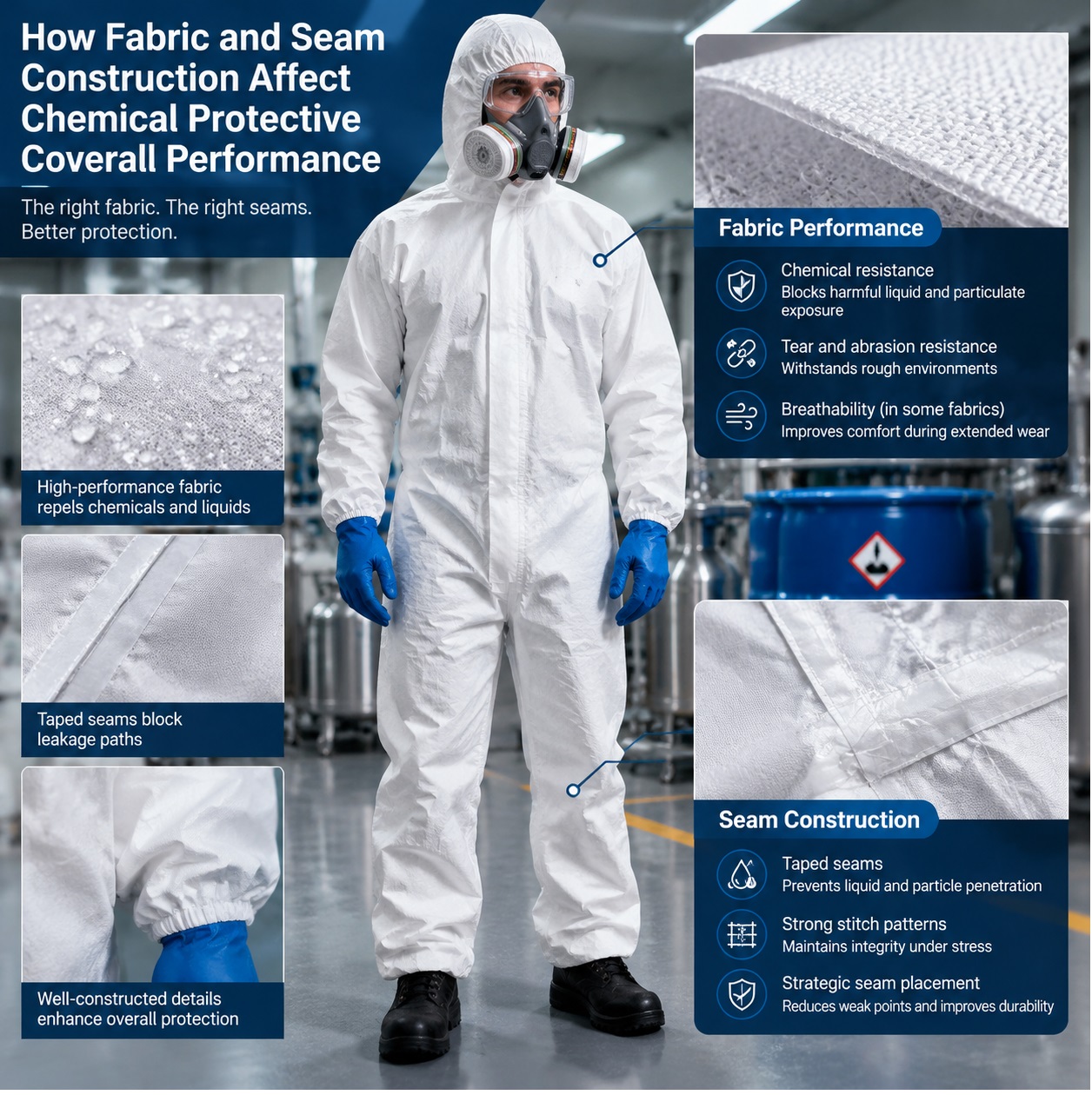
 Most chemical protective coveralls fail at the same place: the seam, not the fabric. Buyers obsess over the shiny outer shell, the color, the logo, the price per unit. Then a worker kneels in a puddle of solvent, or reaches into a tank of fine powder, and the chemical protective coverall becomes a suggestion rather than a shield. The difference between real protection and expensive false confidence comes down to two unglamorous details: what the coverall is made of, and how it is put together.
Fabric is the first barrier, but it is not a single barrier. A microporous film laminated to a nonwoven can block fine particles and liquid splashes, yet it may feel like wearing a plastic bag in August. SMS fabric, made from spunbond, meltblown, and spunbond layers, offers a useful balance of breathability, strength, and particle holdout. A basic spunbond polypropylene coverall may handle dust and dirt, but it is the wrong tool for liquid aerosols or chemical mist. And a heavily coated fabric might resist a splash beautifully while trapping heat so effectively that workers strip it off after twenty minutes. That matters. A coverall that is abandoned is not protecting anyone.
The chemical itself decides which fabric is acceptable. Permeation is not the same as penetration. Penetration is a leak through a physical hole, zipper, or seam. Permeation is a chemical moving through the fabric at a molecular level, often without any visible damage. A fabric can look untouched while the chemical is already crossing to the inside. That is why a supplier should provide permeation data for the specific chemical, concentration, and temperature in your workplace. A generic “chemical resistant” claim is marketing noise. A breakthrough time and permeation rate for your actual hazard is useful information.
Thickness, weight, and lamination quality also shape performance. A heavier fabric may resist abrasion and tearing better, which matters when workers crawl under equipment or push through tight spaces. A poorly laminated film can delaminate, bubble, or crack. A nonwoven with inconsistent fiber distribution can have thin spots that become weak points. Good coverall manufacturers control fabric lot to lot because a small variation can change how the garment behaves under stress. You are not buying cloth. You are buying a engineered barrier.
Then comes the seam. This is where many coveralls quietly give up. Serged seams are common in low-hazard garments. They stitch fabric edges together with thread, leaving tiny needle holes along the join. Bound seams cover the raw edge with a strip of fabric, which improves neatness and some strength, but the stitch line is still there. Taped seams heat-seal a strip over the stitch line, closing the needle holes and creating a continuous barrier. For liquid splashes, aerosols, and fine particles, taped seams are often the difference between a protective coverall and a leak path.
Not all taped seams are equal. The tape must bond consistently to the fabric. If the heat is too low, the tape lifts. If the heat is too high, the fabric puckers or the film is damaged. If the tape is too narrow, it may not cover the stitch holes after the garment flexes. If the operator is rushed, the tape may miss a section near the zipper or crotch. These are not cosmetic defects. They are failure points. A coverall with excellent fabric and sloppy seams is like a bucket with a crack near the bottom.
Zippers and flaps deserve the same scrutiny. A zipper is a mechanical opening, and it is never as protective as uninterrupted fabric. A storm flap over the zipper helps, and a double storm flap with an adhesive or taped closure helps more. Elastic wrists, ankles, and hood openings must seal without cutting off circulation. The interface between the coverall and gloves, boots, and respirators can create gaps. Chemical protection is a system, and the weakest interface sets the system’s limit.
Standards and testing separate claims from performance. EN 14605 covers liquid-tight and spray-tight garments. EN 13982 addresses particulate protection. EN 14126 deals with infectious agents. EN 1149 relates to antistatic properties. EN 14325 classifies fabric and seam performance, including abrasion, tear, puncture, and seam strength. ASTM F903 tests liquid penetration through materials and seams. ASTM F739 tests permeation. A coverall may carry several certifications, but the certification must match the hazard. A Type 5 particulate coverall is not a Type 3 liquid-tight suit. A splash suit is not a gas-tight suit. Marketing language often blurs these distinctions. Safety managers should not.
Comfort is not a soft benefit. It is a compliance tool. If a coverall is hot, stiff, or noisy, workers wear it open, cut the hood, or remove it early. If it restricts movement, they avoid necessary tasks. If it fits poorly, the crotch tears or the sleeves pull out of gloves. A high-performance fabric that manages heat and moisture can keep workers in the garment longer. A well-designed pattern with gussets, raglan sleeves, and generous cuts reduces stress on seams. That is why the best coveralls balance barrier, strength, and breathability instead of maxing out one property.
When you evaluate chemical protective coveralls, ask for the fabric’s permeation and penetration data for your chemicals. Ask how the seams are constructed and whether they are taped, bound, or serged. Ask for seam strength and liquid-tightness test reports. Ask whether the zipper is covered by a single or double storm flap. Ask about antistatic properties if flammable vapors are present. Ask for a sample and test it in your environment. Put it on. Bend. Kneel. Reach. Check the seams under tension. Then decide.
The coverall with the lowest price per unit is rarely the lowest cost per protected worker. A cheap garment that leaks, tears, or overheats creates downtime, exposure, and liability. A better-engineered coverall with the right fabric and sealed seams may cost more upfront, but it does the job it was bought to do. In chemical protection, performance is not a feature. It is the entire point. Choose the barrier your workers can trust, then verify it before the hazard does.